
Google released Gemini 3.8 Flash and Gemini 3.8 Flash Cyber on September 2, 2026, continuing one of the fastest release cadences in the frontier-model market. Gemini 3.8 Flash arrives only weeks after 3.7 Flash and is Google’s third Flash release in roughly six weeks, while the Cyber variant takes the same underlying intelligence and adapts it for high-end defensive security work.
The standard model is the broadly available one. Gemini 3.8 Flash is now generally available through the Gemini API, Google AI Studio, Google Antigravity, Gemini Enterprise and several consumer surfaces. Google positions it as its most capable Flash model yet for long-horizon software engineering, autonomous agents and demanding professional workflows.
The headline is attractive: more intelligence at the same introductory per-token price as Gemini 3.7 Flash. But there is an important catch. Google explicitly says 3.8 Flash “works harder” on difficult tasks, taking more reasoning steps and making iterative tool calls. Independent testing confirms that this can raise the actual cost of completing a task even when the posted token rates are unchanged.
Gemini 3.8 Flash Cyber is a different proposition. It is not an unrestricted public hacking model. Google is making it available to vetted defenders through the Fairwind Program, with an emphasis on vulnerability discovery, defensive patching and securing critical software. Its CyberGym and CWE-Bench results put it near the front of the current cybersecurity-model field.
Key takeaways
-
Gemini 3.8 Flash is generally available now with the model ID
gemini-3.8-flash. - Introductory API pricing is $0.75 per million input tokens and $3.75 per million output tokens through December 31, 2026. Standard pricing doubles on January 1, 2027.
- The model supports a 1 million-token input context and up to 64,000 output tokens, along with text, image, video, audio and PDF input.
- Google exposes low, medium and high thinking levels, with medium as the default. Higher effort can improve difficult agent tasks but may consume materially more tokens.
- Gemini 3.8 Flash reaches roughly 74% on the live DeepSWE v1.1 leaderboard at high effort, placing it alongside Claude Opus 5 while costing far less per benchmark task in that harness.
- Gemini 3.8 Flash Cyber scores 86.2% Pass@1 on CyberGym and 47.2% Pass@1 on CWE-Bench, according to Google.
- Flash Cyber is restricted to trusted government authorities, critical-infrastructure operators, software maintainers and other approved defenders through Fairwind.
What changed in Gemini 3.8 Flash?
Gemini 3.8 Flash is built on Gemini 3.7 Flash, but Google has shifted the optimization target toward sustained agentic work. The company’s current model card describes 3.8 Flash as an advancement across software engineering and agentic knowledge workflows, with customizable effort levels intended to balance quality, cost and latency.
That is a meaningful distinction from simply improving one-shot question answering. A long-running coding or enterprise agent must preserve goals across many steps, decide when to call tools, inspect the result of those calls, recover from failures and determine whether the job is actually finished. The model may need to read code, edit multiple files, run tests, inspect output, revise its plan and repeat the loop several times.
Google says 3.8 Flash was designed to be more diligent in exactly these situations. On difficult work, it takes smaller reasoning steps, calls tools iteratively and verifies its work along the way. The company has also made the model the default for managed Antigravity agents, reinforcing that the primary target is not lightweight chat but production agent execution.
The tradeoff is that diligence costs tokens. A system that checks its own work three times can be more dependable than one that answers immediately, but it can also be more expensive per completed task. That is why reasoning effort is now a first-class deployment choice rather than a hidden model behavior.
Thinking levels: the most important deployment control
Gemini 3.8 Flash supports low, medium and high thinking levels, with medium as Google’s default. The levels let developers change how much reasoning and orchestration the model performs without switching to a different model family.
| Thinking level | Best fit | Main tradeoff |
|---|---|---|
| Low | Latency-sensitive chat, quick drafting, fast analysis, routing | Lower reasoning depth and weaker performance on the hardest tasks |
| Medium | Default production setting, coding and general agent workflows | Balances quality and token use |
| High | Long-horizon coding, difficult analysis, complex tool orchestration | More reasoning, more tokens and potentially longer end-to-end latency |
Artificial Analysis provides a useful independent view of this tradeoff. Its current testing scores Gemini 3.8 Flash at 59 on the Artificial Analysis Intelligence Index with high reasoning, 57 at medium and 52 at low. The measured cost per Intelligence Index task is about $0.58 at high, $0.41 at medium and $0.24 at low.
That makes the model unusually flexible. A company can use low effort for cheap classification or conversational routing, medium for normal production work and high only when the expected value of better reasoning justifies the extra compute.
It also explains why “same price as 3.7 Flash” needs context. Artificial Analysis found that high-effort 3.8 costs around 40% more per evaluated task than high-effort 3.7 even though the per-token prices are identical. The reason was more output tokens and more turns on agentic evaluations. Google is not hiding this behavior; it explicitly recommends lowering effort or continuing to use 3.7 Flash when efficiency is the primary requirement.
Long-horizon coding is the strongest part of the release
Software engineering is where Gemini 3.8 Flash looks most competitive with larger frontier models. Google highlights DeepSWE v1.1, which evaluates agents on original, long-running engineering tasks across real repositories rather than isolated code snippets.
The live DataCurve DeepSWE v1.1 leaderboard currently reports Gemini 3.8 Flash at 74% ±1% at high effort. Claude Opus 5 is also shown at 74%, while GPT-5.6 Sol is at 73%. More notable than the one-point differences is the cost profile: the leaderboard reports an average cost of about $2.36 per Gemini 3.8 Flash task, compared with about $11.84 for Opus 5 and $6.46 for GPT-5.6 Sol in their listed configurations.
| DeepSWE v1.1 | Pass@1 | Average task cost | Listed effort |
|---|---|---|---|
| Gemini 3.8 Flash | 74% ±1% | $2.36 | High |
| Claude Opus 5 | 74% ±4% | $11.84 | Max |
| GPT-5.6 Sol | 73% ±3% | $6.46 | Max |
Those configurations are not identical, so the table should not be interpreted as a controlled laboratory price comparison between providers. It is still useful because it shows what a production-oriented Flash model can accomplish in a realistic coding harness without carrying the unit economics of the most expensive frontier tiers.

Finance, legal work and multidisciplinary reasoning
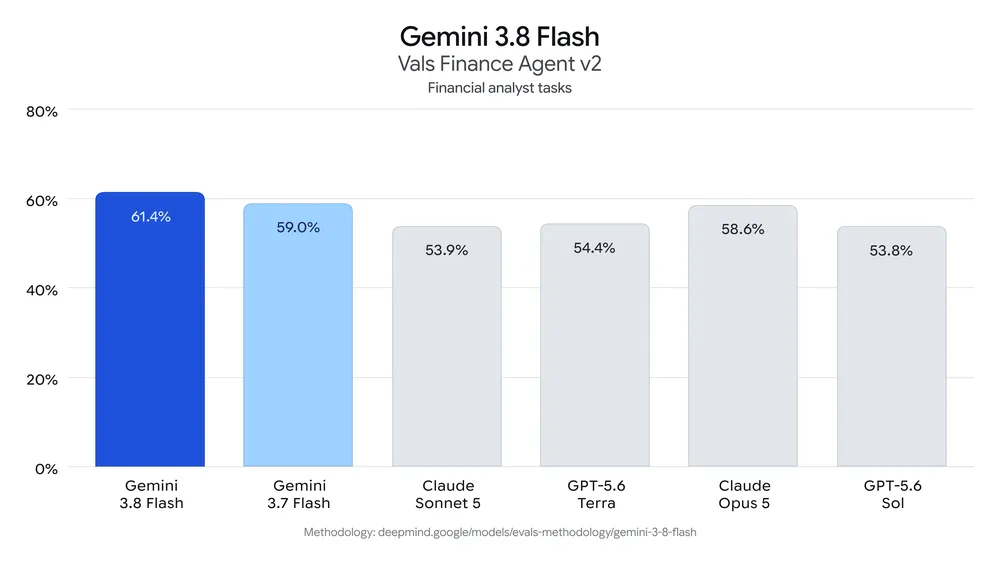
Google is also pushing Flash into professional domains where smaller, cheaper models have historically given up more capability to premium frontier models. The company’s current model page publishes results for Vals Finance Agent V2, Harvey’s Legal Agent Benchmark and HLE-Verified.
| Benchmark | Gemini 3.8 Flash | Gemini 3.7 Flash | Next notable frontier result |
|---|---|---|---|
| Vals Finance Agent V2 | 61.4% | 59.0% | Claude Opus 5: 58.6% |
| Harvey’s Legal Agent Benchmark | 10.0% | 8.8% | Claude Opus 5: 6.7% |
| HLE-Verified | 54.9% | 53.6% | GPT-5.6 Sol: 54.5% |
The legal score deserves the right interpretation. A 10% result is the highest of the models in Google’s displayed comparison, but 10% is still a low absolute success rate. The value of the benchmark is comparative: it suggests improvement in difficult agentic legal workflows, not that the model can autonomously replace expert legal review.
HLE-Verified tells a similar story from another direction. At 54.9%, 3.8 Flash is only narrowly ahead of GPT-5.6 Sol at 54.5% and Claude Opus 5 at 54.4% in Google’s chart. That is effectively a tightly grouped frontier result, and buyers should be skeptical of claims that a few tenths of a point establish universal model superiority.
Pricing now — and the January 2027 increase
Google’s launch headline says 3.8 Flash arrives at the same price as 3.7 Flash. That is true today, but it is an introductory price. Google’s API pricing page states that the current rates run through December 31, 2026 and double on January 1, 2027.
| Gemini 3.8 Flash API | Through Dec. 31, 2026 | Starting Jan. 1, 2027 |
|---|---|---|
| Standard input | $0.75 / 1M | $1.50 / 1M |
| Standard output, including thinking | $3.75 / 1M | $7.50 / 1M |
| Context caching | $0.075 / 1M | $0.15 / 1M |
| Batch/Flex input | $0.375 / 1M | $0.75 / 1M |
| Batch/Flex output | $1.875 / 1M | $3.75 / 1M |
That upcoming increase should be included in any serious 2027 cost model. A workload that looks comfortably inexpensive during the introductory period can have twice the token bill after New Year’s Day before accounting for any change in reasoning behavior.
Google also charges for some grounded search usage after an included allowance. According to the current pricing page, standard paid Gemini 3.x use includes 5,000 Google Search requests per month across the model family before per-request charges apply. Applications that lean heavily on search grounding should therefore model tool charges separately from base token spend.
Context window, multimodal input and tool use
Gemini 3.8 Flash keeps the large working envelope expected from the recent Gemini line. Google lists a 1 million-token input context and 64,000-token maximum output. Inputs can include text, images, video, audio and PDFs; output is text.
For agents, the tool layer is just as important. Google lists support for function calling, search as a tool and computer use. Those capabilities make 3.8 Flash suitable for workflows in which the model has to gather information, operate software and interact with external systems rather than simply respond from its internal context.
A million-token context is not the same thing as perfect million-token reasoning. Large windows reduce the need to discard source material, but retrieval, attention and decision quality can still degrade as jobs become longer and messier. Teams should test their own repository sizes, document collections and agent traces rather than using context-window size as a proxy for reliability.
Gemini 3.8 Flash Cyber is a separate, restricted model
The second launch is more specialized. Gemini 3.8 Flash Cyber uses the same foundational intelligence but is tuned and governed for cybersecurity work. Google says the model has a more permissive set of cyber mitigations than the general-purpose version because legitimate defenders sometimes need capabilities that would be inappropriate to expose without controls.
Accordingly, Flash Cyber is distributed through Google DeepMind’s Fairwind Program. The program prioritizes vetted government authorities, critical-infrastructure operators, software maintainers and other trusted defenders. Google also presents CodeMender as a specialized security agent focused on automating software fixes.
This deployment model is significant. The industry is trying to capture the defensive upside of highly capable cyber models without making every offensive capability universally accessible. Google’s answer is to put the broader model behind an eligibility gate and orient the product around discovery and patching.
CyberGym: 86.2% Pass@1 for vulnerability discovery
On CyberGym, Google reports 86.2% Pass@1 for Gemini 3.8 Flash Cyber. The benchmark evaluates autonomous vulnerability discovery, primarily across C and C++ projects. Google’s Fairwind page shows the new Cyber model narrowly ahead of the other frontier systems in its comparison.
| CyberGym Pass@1 | Score |
|---|---|
| Gemini 3.8 Flash Cyber | 86.2% |
| GPT-5.5-Cyber | 85.6% |
| Mythos 5 | 83.8% |
| GPT-5.6 Sol | 83.6% |
| Gemini 3.5 Flash Cyber | 77.5% |
The margin over GPT-5.5-Cyber is only 0.6 percentage points, so “frontier level” is a better description than “dominant.” The larger generational improvement is against Google’s own 3.5 Flash Cyber result, which is 8.7 points lower in the displayed comparison.

Automated patching: almost the top score at much lower reported cost
Vulnerability discovery is only half the defensive problem. Google says it deliberately prioritized fixing vulnerabilities over offensive exploitation and highlights CWE-Bench, an external benchmark run by Collinear.
Gemini 3.8 Flash Cyber records 47.2% Pass@1 on CWE-Bench, compared with 47.8% for the leading frontier result in Google’s launch material. Google describes the model as sitting on the Pareto frontier because its score is within six-tenths of a point of the leader while operating at substantially lower reported cost.
That is strategically more interesting than winning a benchmark by a fraction. Security teams often need to evaluate thousands of findings, candidate patches or code paths. A model that is close to the highest capability but materially cheaper can become more useful at scale than a model that wins by a narrow margin but is too expensive to run broadly.

Google is already using Flash Cyber on real code
The most consequential claims in the launch are not public leaderboard scores but internal and partner results. They should be treated as vendor-reported evidence because the underlying datasets are not fully public, but they show where Google expects this technology to be deployed.
- Google says the Chrome Security team produced 2.6 times more correct vulnerability patches with 3.8 Flash Cyber than with the best much-larger commercial models it compared.
- Wiz reports 7.5% to 9.7% higher recall on its internal penetration-testing benchmark at 2.3x to 5.2x lower cost than other leading frontier models.
- Google Cloud Vulnerability Research says the model helped find a critical foundational vulnerability in less than two hours, describing the type of research as work that can normally take months.
- Google’s separate internal vulnerability-discovery benchmark spans 20 programming languages and reports a success rate above 70%.
None of those results should be confused with reproducible public benchmarks. They are still valuable because they demonstrate that Google is using the model on its own security workflows rather than presenting Flash Cyber only as a research prototype.
Safety and prompt-injection robustness
Greater agent autonomy increases the importance of prompt-injection resistance. A normal chatbot can be tricked into saying something wrong; an agent with tool access can potentially be tricked into taking an action, leaking context or following hostile instructions embedded inside a webpage or document.
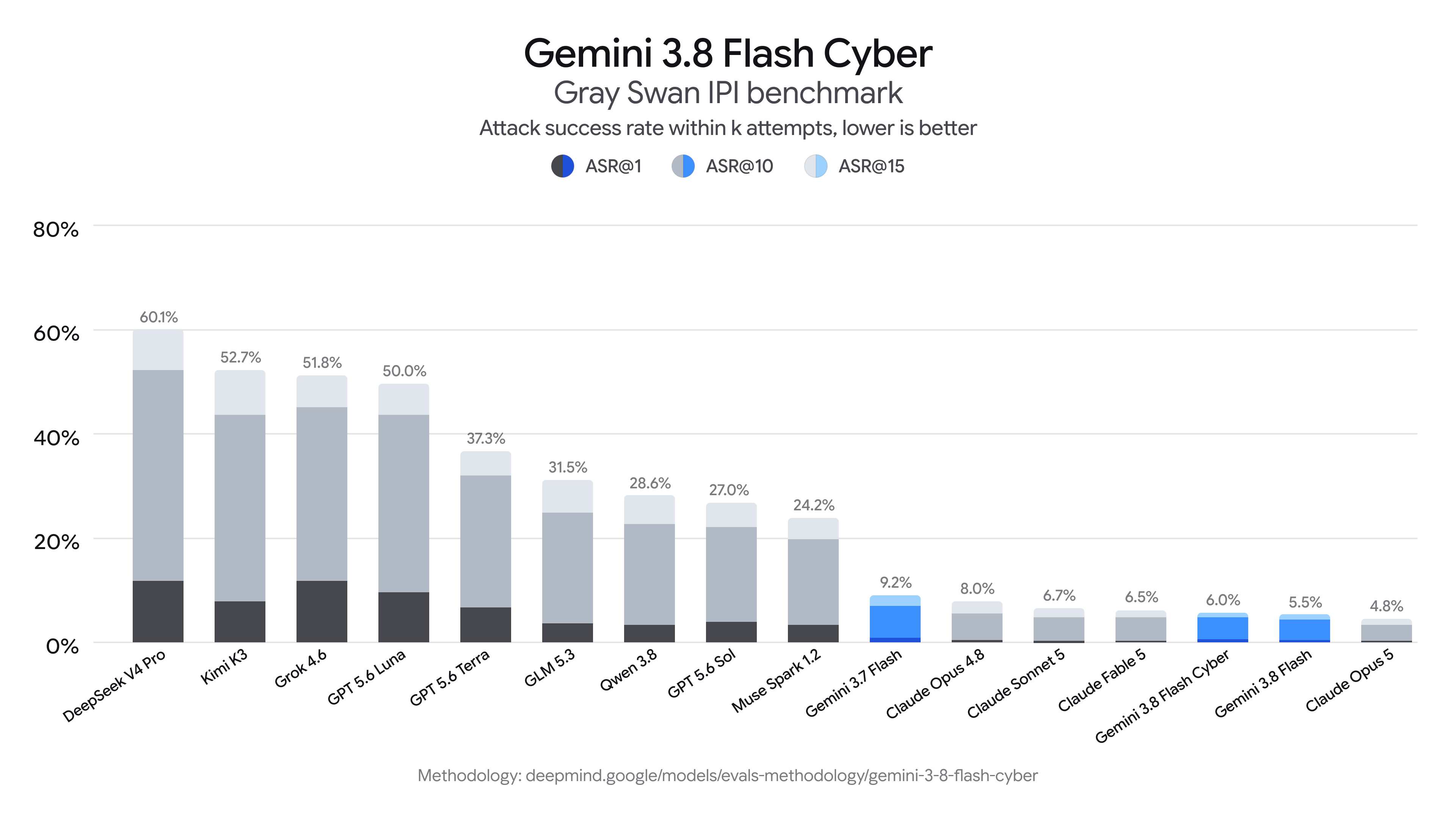
Google says the Gemini 3.8 family made a significant improvement on Gray Swan’s indirect prompt-injection evaluation. The general 3.8 Flash model also retains safeguards for cyber offense and Chemical, Biological, Radiological and Nuclear misuse under Google DeepMind’s Frontier Safety Framework.
The Cyber model deliberately has different mitigations so qualified defenders can perform deeper security work. That is precisely why access is restricted. It is not simply the public Flash model with a “cyber” system prompt; Google treats its distribution and safety boundary as a different product decision.
Where can you use Gemini 3.8 Flash?
The standard model has a broad launch footprint. Developers can use it through the Gemini API and Google AI Studio, while agent builders can work with it through Google Antigravity. Google also lists Android Studio and Stitch among developer entry points.
For enterprises, 3.8 Flash is available through Gemini Enterprise. For consumers, Google says it is available to Google AI Pro and Ultra subscribers across the Gemini app, AI Mode in Search and Gemini in Google Sheets.
Flash Cyber is different: access is through the Fairwind application process rather than normal public API selection.
Should developers move from Gemini 3.7 Flash?
For difficult coding and agent workloads, 3.8 Flash is an obvious model to benchmark. It improves the capabilities Google is emphasizing while preserving the same introductory unit price through the end of 2026. The live DeepSWE result and Artificial Analysis agentic gains suggest that the improvement is not limited to Google’s own internal tests.
But migration should not be automatic. If a workload is dominated by cheap classification, short responses or latency-sensitive interactions, 3.7 Flash may still be the better operating point. Google continues to support it and explicitly recommends it for efficiency-first scenarios.
The right evaluation should measure cost per successful task, not only cost per million tokens. A model can have the same token price and still become more expensive if it generates 30% more output, calls more tools or takes more agent turns. Conversely, the more expensive run can be the cheaper business outcome if it completes difficult tasks correctly on the first attempt and reduces retries or human intervention.
That is the central story of Gemini 3.8 Flash. Google is spending more inference effort to make a low-priced model behave more like a premium agent. The interesting question for developers is not whether that strategy wins a leaderboard. It is whether the extra diligence produces enough additional completed work to justify the additional tokens in their own environment.
What Gemini 3.8 means for Google’s model strategy
Three Flash releases in roughly six weeks show how aggressively Google is iterating on its high-volume model tier. Instead of reserving advanced reasoning and agentic behavior for a single expensive flagship, the company is pushing those capabilities down into Flash while giving developers explicit controls over how much reasoning they want to buy.
Flash Cyber extends the strategy in another direction: domain-specialized capability with a different access boundary. If the Fairwind model works, Google can offer more powerful defensive security tools to vetted organizations without exposing the same capability profile as a normal consumer endpoint.
The result is a model family that is becoming less about “fast versus smart” and more about choosing the appropriate amount of intelligence, tool use and governance for a particular task.
Sources
- Google — Introducing Gemini 3.8 Flash and 3.8 Flash Cyber
- Google DeepMind — Gemini 3.8 Flash
- Google DeepMind — Gemini 3.8 Flash Model Card
- Google AI for Developers — Gemini API Pricing
- Google AI for Developers — What’s New in Gemini 3.8 Flash
- Google DeepMind — Fairwind Program
- DataCurve — DeepSWE v1.1 Leaderboard
- Artificial Analysis — Gemini 3.8 Flash Independent Evaluation