
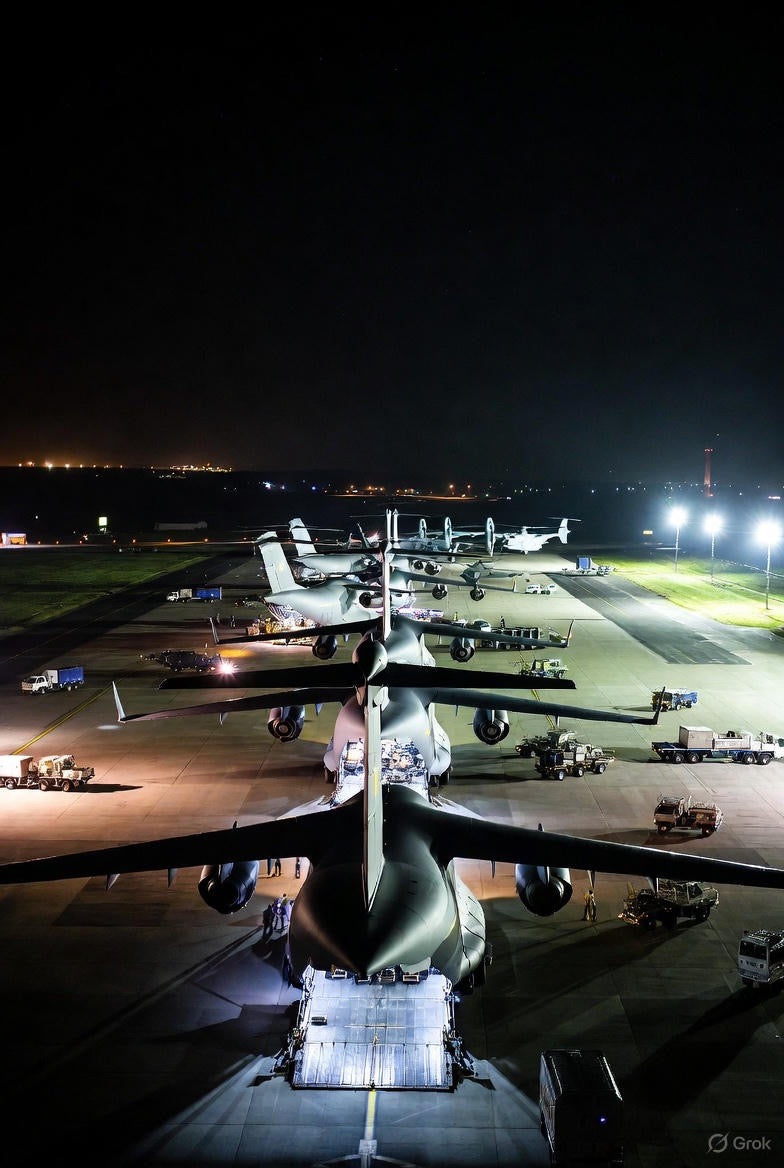
In the early hours of January 4, 2026, aviation enthusiasts and military analysts alike were abuzz with reports of a significant U.S. military movement. Approximately a dozen U.S. Air Force C-17 Globemaster III transport aircraft landed at RAF Fairford in Gloucestershire, United Kingdom, sparking widespread speculation about their purpose.
Coming on the heels of President Trump’s successful operation in Venezuela, which resulted in the capture of Nicolás Maduro, this deployment has raised eyebrows worldwide. Could this be the prelude to a renewed confrontation with Iran? With ongoing U.S.–Iran tensions simmering since the 2025 strikes on Iranian nuclear facilities, the timing feels anything but coincidental.
In this in-depth analysis, we explore the details of the C-17 deployment, the aircraft’s capabilities, historical context, current geopolitical frictions, and what this movement may signal about the risk of a U.S.–Iran conflict in 2026.
The Overnight Arrival: What We Know About the C-17 Deployment
Flight-tracking data and open-source intelligence indicate that between 10 and 12 U.S. Air Force C-17A Globemaster III aircraft crossed the Atlantic overnight on January 3–4, 2026. Most originated from Fort Campbell, Kentucky, and Hunter Army Airfield, Georgia—bases associated with elite formations such as the 101st Airborne Division and the 160th Special Operations Aviation Regiment (SOAR), commonly known as the “Night Stalkers.”
Observers reported the aircraft landing primarily at RAF Fairford, a base frequently used for U.S. strategic operations in Europe. Additional arrivals were noted at Ramstein Air Base in Germany, suggesting a broader repositioning of forces across the European theater.
Some aircraft reportedly disabled civilian transponders while crossing the Atlantic, a standard operational security measure during sensitive military movements. OSINT reports suggest the transports may have carried rotary-wing aircraft such as MH-47 Chinook helicopters, along with specialized equipment supporting special operations missions.
Complementing the C-17 activity, additional assets—including AC-130 gunships and CV-22 Osprey tilt-rotor aircraft—were observed at RAF Mildenhall. The lack of official statements from the U.S. Department of Defense or the UK Ministry of Defence has only fueled speculation about the scale and intent of the operation.
Understanding the C-17 Globemaster III: Capabilities and Strategic Value
The C-17 Globemaster III is one of the most versatile strategic airlifters in the U.S. military inventory. Developed in the late Cold War era and entering service in the mid-1990s, the aircraft was designed to provide rapid global mobility across both strategic and tactical environments.
- Dimensions: Wingspan of 169.8 feet, length of 174 feet, and height of 55.1 feet.
- Payload Capacity: Up to 170,900 pounds, including heavy armored vehicles, helicopters, or more than 100 paratroopers.
- Range and Speed: Approximately 2,400 nautical miles unrefueled, with a cruising speed near Mach 0.74.
- Operational Flexibility: Short takeoff and landing capability on austere runways, in-flight airdrop capability, and thrust reversers allowing backward taxiing.
Powered by four turbofan engines, the C-17 can operate from forward airfields and rapidly insert forces into contested regions. Historically, surges in C-17 deployments have preceded major U.S. military actions, including Iraq, Afghanistan, and the 2025 strikes on Iranian infrastructure.
Escalating U.S.–Iran Tensions: From 2025 to the Present
Relations between Washington and Tehran deteriorated sharply in 2025 following coordinated U.S. and allied strikes against Iranian nuclear facilities. These actions were taken amid intelligence assessments that Iran was approaching weapons-grade enrichment capabilities.
Since then, Iran has faced mounting internal pressure. Inflation exceeding 40 percent, collapsing currency value, and widespread protests have strained the regime. Iranian leadership has accused foreign powers of fueling unrest while simultaneously accelerating ballistic missile development and issuing warnings of retaliation.
Public exchanges between U.S. and Iranian officials have grown increasingly hostile. Iran’s partnerships with Russia and China further complicate the strategic picture, raising concerns about regional escalation and great-power entanglement.
Connecting the Dots: Is Iran the Target?
Analysts note striking similarities between the January 2026 deployment and force movements observed prior to the 2025 Iran strikes. In both cases, C-17 aircraft originated from special operations hubs, deployments occurred rapidly and without advance notice, and strategic airfields in the UK played a central staging role.
While alternative explanations—such as NATO exercises or deterrence messaging toward Russia—remain plausible, the involvement of SOAR-associated assets suggests preparation for high-value, time-sensitive operations. The UK’s geographic position allows rapid projection toward the Middle East, making it an ideal logistics bridge.
Potential Implications for Global Security in 2026
Should this buildup signal imminent conflict, the consequences could be far-reaching. A direct U.S.–Iran confrontation could involve air campaigns, maritime operations in the Persian Gulf, and special operations on the ground. Oil markets would likely react sharply, with global economic ripple effects.
Regionally, allies such as Israel and Gulf states could be drawn in, while Iran’s partners may provide diplomatic or material backing. Internally, Iran’s already fragile stability could deteriorate further, increasing humanitarian risks.
Conclusion: Watching the Horizon
The U.S. C-17 Globemaster III deployment to the United Kingdom in January 2026 represents more than routine airlift activity. In the context of recent military operations, ongoing U.S.–Iran hostility, and the scale of assets involved, it may indicate preparation for contingencies tied to the Middle East.
Until official statements emerge, the deployment remains an open question—but history suggests such movements rarely occur without purpose. As events unfold, close attention to military logistics often provides the earliest clues to what comes next.