
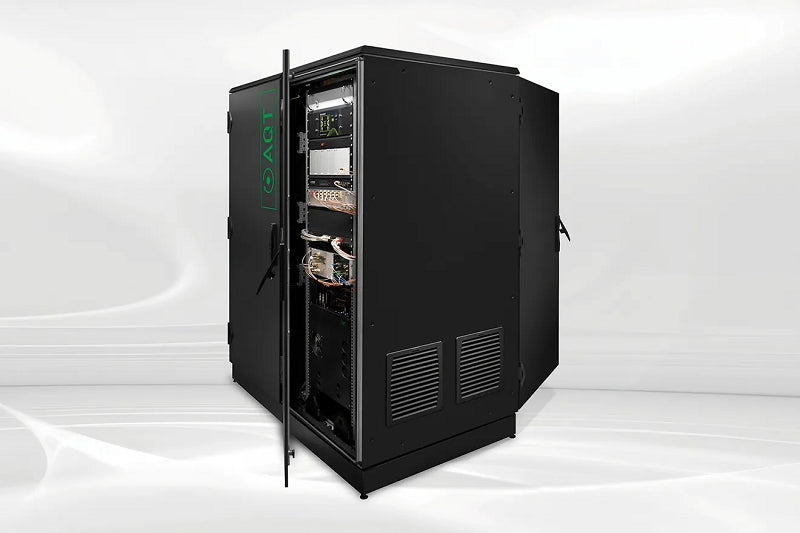
AQT's IBEX-Q1 offers a 12-qubit trapped-ion quantum computer, accessible via AWS Braket, designed for high-fidelity gate-based computations.
As a data analyst evaluating quantum hardware, the introduction of the AQT IBEX-Q1 system marks a significant development in the landscape of cloud-accessible quantum computing. Launched in November 2025 and immediately available on AWS Braket, the IBEX-Q1 represents a robust entry from Alpine Quantum Technologies (AQT) into the commercial quantum space, leveraging their expertise in trapped-ion technology. From a data-driven perspective, this system presents a compelling profile, characterized by its 12 physical qubits, all-to-all connectivity, and notably high gate fidelities, all critical factors for assessing its potential utility in real-world applications.
The strategic decision to deploy IBEX-Q1 on AWS Braket immediately positions it within a widely adopted cloud ecosystem, simplifying access and integration for researchers, developers, and enterprises. This accessibility is paramount for data analysts who need to quickly prototype, test, and benchmark quantum algorithms without the overhead of managing on-premise hardware. The system's 'Public cloud' status means that its performance metrics, pricing model, and operational characteristics are transparent and subject to direct evaluation, enabling informed decision-making regarding resource allocation and project feasibility.
For data analysts, understanding the core capabilities of a quantum system goes beyond mere qubit count. The IBEX-Q1's trapped-ion architecture, specifically designed for discrete, gate-based computation, offers inherent advantages such as long coherence times and the ability to achieve all-to-all connectivity. This latter feature is particularly valuable as it significantly reduces the need for costly SWAP gates in quantum circuits, thereby minimizing circuit depth and mitigating error accumulation – a crucial consideration in the current Noisy Intermediate-Scale Quantum (NISQ) era. The system's stated error rates, with single-qubit fidelity at 99.97% and two-qubit fidelity at 98.7% (as of 2025), are competitive and suggest a strong foundation for executing more complex algorithms with a higher probability of success.
Furthermore, the IBEX-Q1's benchmark of Quantum Volume 128 (also as of 2025) provides a holistic measure of its computational power, encompassing qubit count, connectivity, and error rates. This metric is invaluable for comparing the effective performance of different quantum systems, allowing data analysts to quantify the complexity of problems that can realistically be tackled. While 12 qubits might seem modest compared to some superconducting systems, the quality of these qubits, coupled with their full connectivity, often translates to a more effective computational resource for certain classes of problems, particularly in areas like chemistry simulations, portfolio optimization, and material properties research. The system's low power consumption (<2 kW) and room-temperature operation also highlight its operational efficiency, which can indirectly influence long-term cost-effectiveness and scalability considerations for cloud providers and users alike.
In summary, the AQT IBEX-Q1 system, as evaluated from a data analyst's perspective, presents itself as a high-quality, accessible quantum computing resource. Its strong technical specifications, transparent cloud access, and clear pricing model make it a valuable tool for exploring the practical applications of quantum algorithms. The focus on fidelity and connectivity, rather than just raw qubit count, underscores a mature approach to quantum hardware development that directly addresses the challenges of the NISQ era, offering a platform where meaningful quantum computations can be pursued with a higher degree of confidence.
| Spec | Details |
|---|---|
| System ID | aqt-ibex-q1 |
| Vendor | AQT |
| Technology | Trapped-ion |
| Status | Public cloud |
| Primary metric | 12 physical qubits |
| Metric meaning | Number of fully-connected trapped-ion qubits |
| Qubit mode | Discrete qubits using trapped ions for gate-based computation |
| Connectivity | All-to-all |
| Native gates | RZ | R | RXX |
| Error rates & fidelities | Single-qubit fidelity 99.97% (2025) | Two-qubit fidelity 98.7% (2025) |
| Benchmarks | Quantum Volume 128 (2025) |
| How to access | AWS Braket |
| Platforms | AWS Braket |
| SDKs | OpenQASM | Qiskit |
| Regions | us-east-1 (est.) |
| Account requirements | Free AWS account |
| Pricing model | Pay-per-task/shot |
| Example prices | Task $0.30 | Shots $0.0235/1000 (2025) |
| Free tier / credits | No |
| First announced | 2025-11-18 |
| First available | 2025-11-18 |
| Major revisions | None |
| Retired / roadmap | Active; roadmap to larger systems |
| Notes | Consumes <2 kW; executes up to 2000 gates |
The AQT IBEX-Q1 system is engineered around a trapped-ion architecture, a technology renowned for its intrinsic qubit stability, long coherence times, and high gate fidelities. This system specifically utilizes 12 physical qubits, each represented by a single trapped ion. From a data analyst's standpoint, the 'physical qubit' count is a fundamental metric, but its true value is unlocked by understanding the underlying technology. Trapped ions offer a discrete qubit mode, meaning each qubit is a distinct, isolated quantum system, which contributes to the system's overall robustness against environmental noise. This design choice is critical for maintaining the integrity of quantum states throughout computation.
One of the most significant advantages of the IBEX-Q1 is its all-to-all connectivity topology. In many quantum architectures, qubits can only interact with their nearest neighbors, necessitating a series of 'SWAP' gates to move quantum information across the chip. These SWAP operations consume valuable circuit depth and introduce additional opportunities for errors. With all-to-all connectivity, any qubit can directly interact with any other qubit, dramatically simplifying circuit compilation and reducing the overall gate count required for complex algorithms. For data analysts, this translates directly into more efficient algorithm execution, potentially higher success probabilities for given circuit depths, and a reduced need for complex qubit mapping strategies, which can be a significant bottleneck in algorithm development and optimization.
The system's native gate set includes RZ, R, and RXX gates. These are fundamental building blocks for universal quantum computation. The RZ gate represents a rotation around the Z-axis of the Bloch sphere, while the R gate (often denoting a general single-qubit rotation) and RXX (a two-qubit entangling gate) allow for the construction of any arbitrary quantum operation. The availability of these gates directly impacts the expressiveness and flexibility of quantum circuits that can be implemented on the IBEX-Q1. Data analysts can leverage standard quantum programming frameworks like OpenQASM and Qiskit, which abstract these native gates, but understanding the underlying gate set is crucial for advanced circuit optimization and error analysis.
Error rates and fidelities are perhaps the most critical metrics for assessing the practical utility of any NISQ-era quantum computer. The AQT IBEX-Q1 boasts impressive figures: a single-qubit fidelity of 99.97% and a two-qubit fidelity of 98.7% (as of 2025). These numbers are indicative of a high-quality system. Single-qubit fidelity measures how accurately a single qubit operation is performed, while two-qubit fidelity measures the accuracy of entangling operations, which are typically more prone to errors. For data analysts, higher fidelities directly correlate with a greater likelihood of obtaining correct results from quantum algorithms, especially as circuit depth increases. These figures are competitive within the trapped-ion landscape and are essential for pushing the boundaries of what's achievable with current quantum hardware, particularly for applications requiring precise state preparation and measurement.
To provide a holistic performance measure, the IBEX-Q1 has achieved a Quantum Volume (QV) of 128 (as of 2025). Quantum Volume is a benchmark that considers qubit count, connectivity, gate fidelity, and measurement errors to quantify the largest square quantum circuit that a system can reliably execute. A higher QV indicates a more powerful and reliable quantum computer for general-purpose algorithms. For data analysts, QV serves as a valuable, single-number proxy for comparing the effective computational capability of different quantum systems, helping to identify which hardware is best suited for algorithms of a given complexity.
Understanding the system limits is crucial for job planning and resource management. The IBEX-Q1 allows for an unlimited number of shots per job, which is highly beneficial for statistical analysis, error mitigation techniques (like Zero Noise Extrapolation), and obtaining robust measurement outcomes. The system supports circuits with a depth of up to 1000 gates, providing ample room for many NISQ-era algorithms, though highly complex or fault-tolerant circuits would exceed this. Estimated queue times are typically less than 5 minutes, suggesting efficient job scheduling and good availability for cloud users. Furthermore, the system operates with remarkably low power consumption, under 2 kW, and at room temperature, which contributes to its operational efficiency and scalability. The ability to execute up to 20,000 circuits per hour underscores its throughput capabilities, making it suitable for iterative algorithm testing and parameter sweeps.
The AQT IBEX-Q1 is positioned for a range of applications, including gate-based algorithms, chemistry simulations, portfolio optimization, and the study of material properties. Its high fidelity and all-to-all connectivity make it particularly well-suited for problems where precise quantum state manipulation and entanglement are critical. However, it's important to acknowledge the trade-offs. While offering exceptional qubit quality and connectivity, the system is currently limited to 12 qubits. This places it firmly within the NISQ era, meaning it is not yet capable of solving problems intractable for classical supercomputers, but it is an excellent platform for exploring quantum advantage in specific domains and for developing foundational quantum algorithms. Its rack-mountable design also points to future scalability and integration potential within data centers.
The journey of the AQT IBEX-Q1 system into the public domain is a testament to the rapid advancements in quantum hardware commercialization. The system was first announced and made publicly available on November 18, 2025. This simultaneous announcement and availability on AWS Braket highlights a streamlined go-to-market strategy, allowing immediate access for researchers and developers globally. For a data analyst, this immediate availability is a significant advantage, as it bypasses lengthy beta programs and allows for prompt evaluation and integration into existing workflows.
The year 2025 marks a pivotal moment for AQT, as the IBEX-Q1 represents their entry into the cloud quantum computing market with a production-ready system. This launch is not merely an incremental update but a foundational release, establishing AQT as a key player in the trapped-ion segment. The fact that there have been no major revisions reported since its launch suggests a stable and well-engineered initial product, which is crucial for building user confidence and ensuring consistent performance metrics for benchmarking and application development.
The IBEX-Q1 is currently designated as 'Active', with a clear roadmap towards larger systems. This indicates AQT's commitment to continuous development and scaling of their trapped-ion technology. For data analysts and quantum strategists, this roadmap is important for long-term planning, as it suggests a path for future algorithm development that can leverage increased qubit counts and potentially enhanced capabilities. The system's status as the first EU-hosted trapped-ion quantum computer on Braket also underscores its regional significance and contribution to the global quantum ecosystem.
Historically, the development of trapped-ion quantum computers has been a complex and resource-intensive endeavor. AQT's ability to bring a 12-qubit system with such high fidelities to market and integrate it into a major cloud platform like AWS Braket within this timeframe speaks volumes about their engineering prowess and strategic partnerships. The 2025 launch date positions the IBEX-Q1 as a contemporary tool in the NISQ era, directly competing with other leading quantum hardware providers. Its immediate accessibility means that the quantum community can begin exploring its capabilities and limitations without delay, contributing to the collective understanding of practical quantum advantage.
The absence of a 'retired' status further confirms its active role in AQT's product portfolio and its ongoing relevance for quantum computing research and development. This continuous availability and commitment to a future roadmap provide a stable platform for users to invest their time and resources in developing quantum applications, with the assurance that the underlying hardware will continue to evolve and improve.
Verification confidence: High. Specs can vary by revision and access tier. Always cite the exact device name + date-stamped metrics.
The AQT IBEX-Q1 is a 12-qubit trapped-ion quantum computer developed by Alpine Quantum Technologies (AQT). It is designed for gate-based quantum computation, featuring all-to-all qubit connectivity and high gate fidelities. It was launched in November 2025 and is accessible via Amazon Braket.
The IBEX-Q1 is publicly accessible through AWS Braket, Amazon's cloud quantum computing service. You will need a free AWS account to get started. It supports quantum circuit definition using SDKs like OpenQASM and Qiskit, allowing you to submit jobs and retrieve results through the Braket API.
Key performance metrics (as of 2025) include 12 physical trapped-ion qubits with all-to-all connectivity. It boasts a single-qubit fidelity of 99.97% and a two-qubit fidelity of 98.7%. The system has achieved a Quantum Volume of 128 and can execute up to 1000 gates per circuit. It also features low power consumption (<2 kW) and room-temperature operation.
The IBEX-Q1 is well-suited for gate-based algorithms, particularly in areas like chemistry simulations, portfolio optimization, and the study of material properties. Its high fidelity and all-to-all connectivity make it effective for exploring quantum advantage in NISQ-era applications where precise quantum state manipulation is crucial.
The pricing model for IBEX-Q1 on AWS Braket is pay-per-task/shot. As of 2025, example pricing is $0.30 per task and $0.0235 per 1000 shots. Costs are primarily driven by the duration of the task and the total number of shots executed. There is no explicit free tier for this system.
While offering high quality, the IBEX-Q1 is currently limited to 12 qubits, placing it within the Noisy Intermediate-Scale Quantum (NISQ) era. This means it's not yet capable of solving problems intractable for classical supercomputers. Circuit depth is limited to approximately 1000 gates. These limitations are typical for current quantum hardware, but its high fidelity and connectivity help mitigate some of these challenges.
Based on available information, there is no dedicated free tier or free credits explicitly mentioned for the AQT IBEX-Q1 system on AWS Braket. Users are advised to check the latest AWS Braket pricing details for any updates or promotional offers that may become available.