
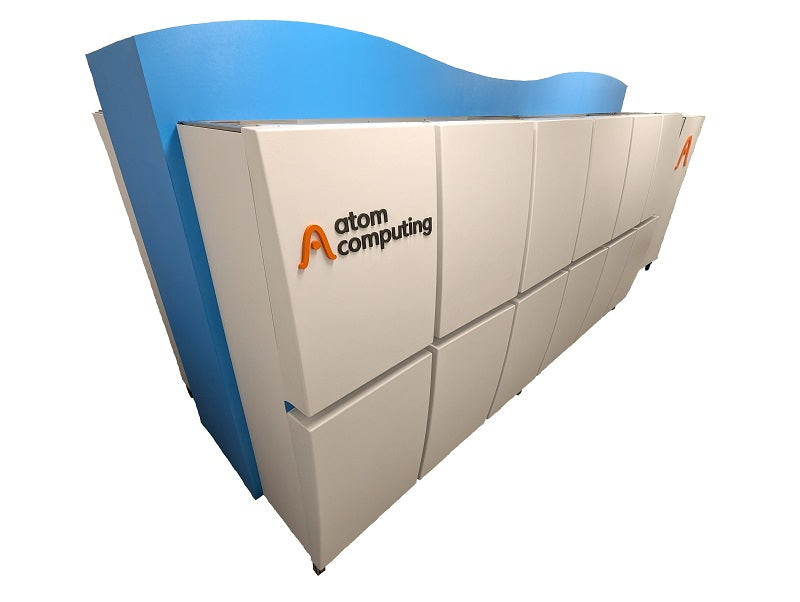
This foundational 100-qubit neutral atom system, codenamed Phoenix, demonstrated key capabilities for large-scale quantum computing before being superseded by a more powerful successor.
The Atom Computing 100-qubit system, known internally as 'Phoenix', represented a significant milestone in the development of neutral atom quantum computing. Launched in 2021, this prototype system showcased the potential of optically-trapped neutral atoms, specifically strontium-87, as a highly scalable and robust platform for gate-based quantum computation. As a data analyst evaluating quantum hardware, understanding the Phoenix system is crucial for appreciating the rapid advancements and unique characteristics of the neutral atom modality, even though it has since been superseded.
At its core, the Phoenix system leveraged the inherent advantages of neutral atoms: their identical nature, long coherence times, and the potential for dense, reconfigurable arrays. Unlike other quantum computing modalities that rely on superconducting circuits or trapped ions, neutral atom systems use highly focused laser beams, known as optical tweezers, to trap and manipulate individual atoms. These atoms, when cooled to ultra-low temperatures, act as qubits. The choice of strontium-87 is particularly noteworthy because it utilizes nuclear spin as the qubit encoding. Nuclear spins are exceptionally well-isolated from environmental noise, contributing to the system's impressive coherence properties.
The introduction of a 100-qubit system in 2021 positioned Atom Computing as a frontrunner in the race for larger qubit counts, especially within the neutral atom space. At the time, achieving 100 physical qubits with demonstrated high-fidelity operations was a substantial technical feat. This system was not merely a static demonstration; it was designed as a dynamic testbed for advancing the fundamental science and engineering required for fault-tolerant quantum computing. Its capabilities extended to supporting parallel gate operations, enabling entanglement through Rydberg interactions, and facilitating mid-circuit measurements – all critical components for complex quantum algorithms and error correction schemes.
From an analytical perspective, the Phoenix system provided invaluable data points regarding the scalability and performance characteristics of neutral atom technology. It validated the concept of using nuclear-spin qubits in arrays and laid the groundwork for subsequent generations of hardware. While it was primarily an internal research platform and never offered for public access or commercial use, its impact on the field is undeniable. It served as a proof-of-concept that neutral atom systems could not only scale to significant qubit numbers but also maintain the coherence and control necessary for meaningful quantum operations. The insights gained from the Phoenix system directly informed the design and rapid development of Atom Computing's more powerful 1200-qubit successor, which was announced in 2023, underscoring the accelerated pace of innovation in this sector.
The Phoenix system's contribution to the exploration of logical qubits is also a key highlight. It enabled early experiments aimed at demonstrating the principles of quantum error correction, with the potential to support up to 28 logical qubits in some configurations, and later work building upon its foundation even explored 64 logical qubits. This focus on logical qubits, rather than just raw physical qubit count, indicates a forward-looking approach towards fault-tolerant quantum computing, which is the ultimate goal for many complex applications. For data analysts, this system represents a critical data point in the evolution of quantum hardware, illustrating how a prototype can rapidly advance a technology from theoretical promise to practical demonstration, paving the way for future, more powerful systems.
| Spec | Details |
|---|---|
| System ID | atom-computing-100 |
| Vendor | Atom Computing |
| Technology | Neutral atom |
| Status | Prototype superseded |
| Primary metric | 100 physical qubits |
| Metric meaning | Number of optically-trapped neutral atom qubits |
| Qubit mode | Discrete nuclear-spin qubits using alkaline earth atoms |
| Connectivity | Not specified |
| Native gates | Single-qubit | Two-qubit via Rydberg |
| Error rates & fidelities | Not publicly confirmed; coherence 40s (2022) |
| Benchmarks | High-fidelity operations (2021) |
| How to access | Not public |
| Platforms | None |
| SDKs | None |
| Regions | N/A |
| Account requirements | None |
| Pricing model | None |
| Example prices | None |
| Free tier / credits | None |
| First announced | 2021-07-21 |
| First available | 2021-07-21 |
| Major revisions | None |
| Retired / roadmap | Superseded by 1200-qubit system 2023 |
| Notes | Phoenix system; enabled 64 logical qubits in later work |
The Atom Computing 100-qubit system, Phoenix, was engineered to push the boundaries of neutral atom quantum computing, focusing on scalability, coherence, and high-fidelity operations. As a data analyst, understanding its specific capabilities and limitations is essential for contextualizing its impact and comparing it against other quantum hardware platforms.
Technology Foundation: Neutral Atoms and Strontium-87The system's core technology relies on optically-trapped neutral atoms. Specifically, it uses individual atoms of strontium-87, an alkaline earth element. These atoms are cooled to extremely low temperatures and held in place by arrays of highly focused laser beams, known as optical tweezers. The qubit information is encoded in the nuclear spin states of the strontium-87 atoms. This choice of nuclear spin qubits is a critical differentiator, as nuclear spins are inherently well-isolated from environmental electromagnetic noise, leading to significantly longer coherence times compared to electron spin qubits or superconducting transmon qubits. The identical nature of atoms also simplifies manufacturing and ensures uniformity across all qubits, a major advantage for scaling.
Qubit Count and ScalabilityWith 100 physical qubits, the Phoenix system represented a substantial leap for neutral atom platforms at its launch in 2021. This qubit count was competitive with, and in some cases exceeded, systems from other modalities available at that time. The architecture of neutral atom systems, where qubits are individual atoms manipulated by lasers, inherently offers a clear path to scaling. The ability to create larger arrays of optical tweezers directly translates to more qubits. The rapid progression from 100 qubits to a 1200-qubit successor within two years underscores the high scalability potential validated by the Phoenix system.
Qubit Encoding and CoherenceThe use of discrete nuclear-spin qubits in strontium-87 atoms is a defining characteristic. This encoding choice is directly responsible for the system's remarkable coherence properties. In 2022, Atom Computing publicly reported coherence times of up to 40 seconds for these qubits. To put this into perspective for a data analyst, this is orders of magnitude longer than typical coherence times for superconducting qubits (microseconds) and significantly longer than many trapped-ion systems (seconds). Long coherence times are paramount for executing complex quantum algorithms, as they allow for more gate operations before quantum information is lost due to decoherence.
Gate Operations and EntanglementThe Phoenix system supported both single-qubit and two-qubit gate operations. Single-qubit gates are performed by precisely tuned local laser pulses that manipulate the nuclear spin state of individual atoms. Two-qubit gates, essential for creating entanglement, are achieved via Rydberg interactions. This involves exciting two nearby atoms into highly energetic Rydberg states, where they interact strongly over relatively long distances. This interaction creates the necessary coupling for entangling gates. The ability to perform these gates with high fidelity was demonstrated in 2021, laying the groundwork for complex quantum circuits. Furthermore, neutral atom systems offer the potential for parallel gate operations across multiple qubit pairs simultaneously, which can significantly speed up computation.
Connectivity and TopologyA key piece of information for hardware analysis, the specific connectivity topology of the 100-qubit Phoenix system was not publicly specified. In neutral atom systems, connectivity can be highly flexible and reconfigurable, as atoms can be physically moved within the optical trap array. However, the native two-qubit gate mechanism via Rydberg interactions typically implies a certain range of interaction. The lack of specific public details on connectivity means that for an analyst, assumptions about all-to-all or specific nearest-neighbor connectivity cannot be made without further verification. This often implies that connectivity might be limited or dynamically reconfigured for specific experiments.
Error Rates and FidelityWhile Atom Computing demonstrated 'high-fidelity operations' in 2021, specific, publicly confirmed error rates for single and two-qubit gates were not disclosed for the Phoenix system. For a data analyst, the absence of these precise metrics (e.g., average single-qubit gate fidelity, two-qubit gate fidelity) makes direct quantitative comparison with other platforms challenging. High fidelity is a qualitative statement; precise error rates are crucial for estimating the overheads of quantum error correction and the feasibility of running specific algorithms. The long coherence time, however, suggests a strong foundation for achieving low error rates, as decoherence is a primary source of errors.
System Architecture and FeaturesThe Phoenix system operated within a sophisticated multi-chamber vacuum setup, essential for isolating the neutral atoms from environmental contaminants and maintaining the ultra-high vacuum required for their stability. It also featured capabilities like mid-circuit measurement, which is vital for implementing quantum error correction codes and adaptive quantum algorithms. The system was instrumental in demonstrating the first nuclear-spin qubits in arrays, a foundational step for this technology.
Applications and Trade-offsThe Phoenix system was designed for gate-based quantum computing, enabling the execution of quantum circuits and algorithms. A significant focus was on demonstrating logical qubits, with the system supporting experiments that could involve up to 28 logical qubits, and later work building on this technology explored 64 logical qubits. This capability is critical for moving towards fault-tolerant quantum computing. The primary trade-offs included its status as a prototype with no public access, meaning its capabilities were explored in a controlled research environment. While offering long coherence and scalable arrays, the complexity of the laser control systems and vacuum infrastructure represents engineering challenges inherent to the neutral atom approach.
| System | Status | Primary metric |
|---|---|---|
| Atom Computing 1,225-Qubit System | Available | physical qubits: 1225 |
The Atom Computing 100-qubit system, codenamed Phoenix, marked a pivotal period in the company's journey and the broader neutral atom quantum computing landscape. Its lifecycle, though relatively short as a flagship system, was characterized by rapid innovation and significant technological validation.
Atom Computing officially announced its 100-qubit quantum computing system. This marked a significant public debut, showcasing a substantial qubit count for a neutral atom platform. The system, leveraging optically-trapped strontium-87 atoms, was immediately available for internal research and development. This announcement was a strong signal to the quantum community about the scalability potential of neutral atom technology and Atom Computing's aggressive roadmap.
Following its announcement, Atom Computing focused on validating the core functionalities of the Phoenix system. During this period, the company demonstrated high-fidelity operations for both single-qubit and two-qubit gates, crucial for executing complex quantum circuits. These demonstrations were vital in proving the viability of nuclear-spin qubits and Rydberg interactions as the foundation for gate-based quantum computing.
A significant technical achievement was reported in 2022: the Phoenix system demonstrated coherence times of up to 40 seconds for its nuclear-spin qubits. This was a groundbreaking result, highlighting the exceptional robustness and isolation of the strontium-87 nuclear spins. Such long coherence times are a critical enabler for running deeper quantum circuits and for the eventual implementation of quantum error correction, as they minimize the impact of decoherence on quantum computations.
Throughout its operational period, the Phoenix system served as a primary testbed for Atom Computing's internal research. This included continuous improvements in qubit control, gate fidelities, and exploration of advanced quantum algorithms. A key focus was on the development and demonstration of logical qubits. The system's capabilities enabled early experiments with quantum error correction, with the potential to support configurations involving 28 logical qubits, and later foundational work that explored up to 64 logical qubits. This work was instrumental in advancing the understanding of how to build fault-tolerant quantum computers using neutral atoms.
In 2023, the 100-qubit Phoenix system was officially superseded by Atom Computing's next-generation 1200-qubit quantum computer. This rapid transition underscores the aggressive scaling potential of neutral atom technology. While the Phoenix system was retired as the flagship, its legacy is profound. It successfully validated the core principles of nuclear-spin neutral atom qubits, demonstrated significant qubit counts, achieved industry-leading coherence, and laid the essential groundwork for the subsequent, much larger system. Its role as a foundational prototype was critical in accelerating Atom Computing's roadmap towards large-scale, fault-tolerant quantum computing.
Verification confidence: High. Specs can vary by revision and access tier. Always cite the exact device name + date-stamped metrics.
The Atom Computing 100-qubit system, codenamed Phoenix, was a prototype quantum computer launched in 2021. It utilized optically-trapped neutral atoms of strontium-87 as its qubits, demonstrating a significant step forward in the scalability and performance of neutral atom quantum computing before being superseded by a larger system in 2023.
It employed neutral atom technology, specifically using the nuclear spin states of strontium-87 atoms as qubits. These atoms were trapped and manipulated by arrays of optical tweezers (laser beams), allowing for precise control and interaction. This approach is known for its potential for high scalability and long qubit coherence times.
The system featured 100 physical qubits and demonstrated high-fidelity single and two-qubit operations. A notable metric was its reported coherence time of up to 40 seconds in 2022, which is exceptionally long compared to many other quantum computing modalities. Specific gate error rates, however, were not publicly confirmed.
No, the 100-qubit Phoenix system was a prototype and has been superseded by Atom Computing's next-generation 1200-qubit system in 2023. It was never publicly accessible or offered as a commercial service, serving primarily as an internal research and development platform.
The Phoenix system was highly significant as it validated the core principles of nuclear-spin neutral atom qubits for gate-based quantum computing. It demonstrated the scalability of the technology to 100 qubits, achieved industry-leading coherence times, and laid crucial groundwork for the rapid development of larger systems. It also enabled early experiments in logical qubit demonstrations, contributing to the path towards fault-tolerant quantum computing.
The system was instrumental in early experiments for logical qubit demonstrations and quantum error correction. It was designed with capabilities like mid-circuit measurement, which are essential for implementing error-correcting codes. While specific results are largely internal, the system's architecture and performance allowed for foundational work that explored the potential for up to 28 logical qubits, and later work building on this technology explored 64 logical qubits.
Key limitations and unconfirmed details include the lack of publicly specified qubit connectivity topology and the absence of specific, publicly confirmed error rates for single and two-qubit gates. While high-fidelity operations were demonstrated, precise quantitative metrics are crucial for detailed performance analysis and comparison. Its prototype status also meant it was not designed for external commercial use.