
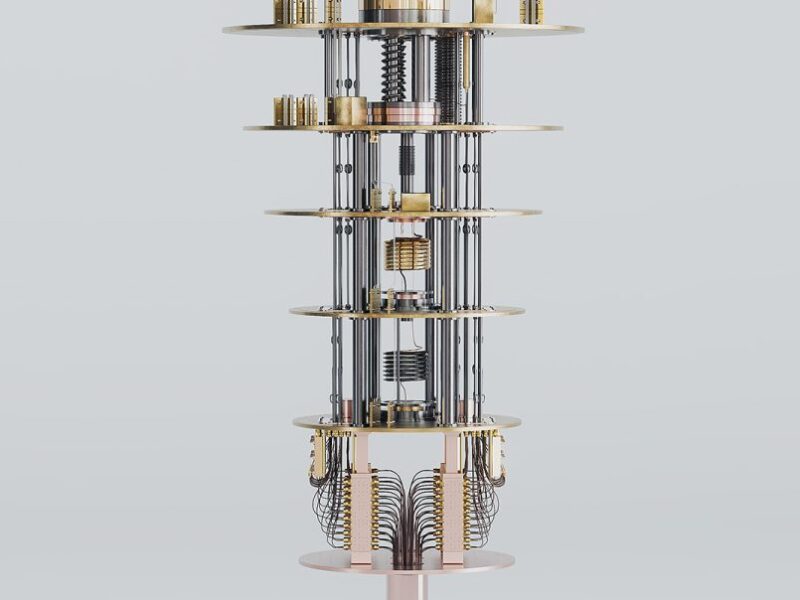
The OQC Toshiko is a 32-qubit superconducting quantum processor designed for enterprise applications and colocation deployment.
The OQC Toshiko represents a significant entry into the quantum computing landscape, particularly for its strategic positioning as the world's first enterprise-ready quantum platform. Launched by Oxford Quantum Circuits (OQC) in late 2023, this system is built upon superconducting technology, specifically utilizing 32 physical qubits based on OQC's patented Coaxmon architecture. From a data analyst's perspective, Toshiko's primary metric of 32 physical qubits provides a clear, albeit foundational, starting point for evaluating its computational capacity. However, the true differentiator lies not just in its qubit count, but in its deployment model: designed for colocation within existing data centers in regions such as the UK, Spain, and Japan. This approach aims to address critical enterprise concerns around data security, latency, and integration with high-performance computing (HPC) infrastructure, setting it apart from many cloud-only quantum offerings.
OQC's vision for Toshiko extends beyond raw qubit numbers, focusing on delivering a practical, secure, and scalable quantum solution for demanding sectors. The 'enterprise-ready' designation implies a focus on reliability, robust support, and seamless integration into complex IT environments, which are often overlooked in early-stage quantum hardware development. The colocation model is particularly noteworthy; by bringing the quantum computer directly into a customer's or partner's data center, OQC seeks to minimize data transfer risks and enable tighter coupling with classical computational resources. This hybrid quantum-HPC paradigm is crucial for many real-world applications where quantum algorithms will likely serve as accelerators for specific, computationally intensive sub-problems within larger classical workflows. For data analysts evaluating quantum solutions, this deployment strategy suggests a strong emphasis on operational efficiency and data governance, which are paramount for industries like finance, pharmaceuticals, and energy.
The underlying technology, superconducting qubits, is a well-established and actively researched modality in quantum computing. OQC's proprietary Coaxmon architecture is touted for its scalability and performance, though specific technical details regarding its advantages in coherence or gate fidelity are not publicly confirmed at this stage. The choice of discrete qubits for gate-based computation aligns with the dominant paradigm for universal quantum computing, allowing for the execution of a wide range of quantum algorithms. The system's availability via direct Quantum Computing as a Service (QCaaS) through the OQC Cloud, as well as its colocation option, underscores a flexible access strategy tailored to different enterprise needs. While currently in private preview, its strategic launch and the substantial funding round supporting OQC highlight a concerted effort to transition quantum computing from a research curiosity to a tangible, deployable asset for businesses seeking a competitive edge. Understanding these foundational aspects is crucial for any analyst assessing the potential impact and practical utility of the OQC Toshiko in a rapidly evolving technological landscape.
| Spec | Details |
|---|---|
| System ID | oqc-toshiko |
| Vendor | OQC |
| Technology | Superconducting |
| Status | Private preview |
| Primary metric | 32 physical qubits |
| Metric meaning | Number of superconducting coaxmon qubits |
| Qubit mode | Discrete qubits using superconducting coaxmons for gate-based computation |
| Connectivity | Not specified |
| Native gates | Not specified |
| Error rates & fidelities | Not publicly confirmed; checked vendor site, no rates |
| Benchmarks | Not specified |
| How to access | Direct QCaaS | OQC Cloud |
| Platforms | OQC Cloud | Colocation data centers |
| SDKs | Qiskit | OpenQASM |
| Regions | UK | Spain | Japan |
| Account requirements | Enterprise signup |
| Pricing model | Enterprise on request |
| Example prices | Not public |
| Free tier / credits | No |
| First announced | 2023-11-27 |
| First available | 2023-11-27 |
| Major revisions | None |
| Retired / roadmap | Active; roadmap to GENESIS |
| Notes | World's first enterprise QC platform |
From a technical capability standpoint, the OQC Toshiko is anchored by its 32 physical qubits, which are superconducting coaxmon qubits. This metric, while fundamental, requires careful interpretation. 'Physical qubits' refer to the raw quantum bits available on the chip, distinct from 'logical qubits' which would incorporate error correction. For current-generation quantum computers, the number of physical qubits directly dictates the maximum problem size that can be mapped onto the hardware, assuming sufficient connectivity and coherence. OQC's use of superconducting coaxmons is a specific architectural choice within the broader superconducting qubit family, designed to offer advantages in terms of scalability and reduced crosstalk, though detailed performance metrics supporting these claims are not yet publicly available for Toshiko.
The qubit mode is described as discrete qubits using superconducting coaxmons for gate-based computation. This confirms Toshiko as a universal gate-based quantum computer, capable of executing arbitrary quantum circuits. This is the most versatile approach to quantum computing, allowing for a broad spectrum of algorithms from optimization to simulation and cryptography. However, the effectiveness of these algorithms is heavily dependent on the quality of the qubits and the gates. Unfortunately, critical metrics such as connectivity topology and native gates are not specified. Connectivity is vital for efficient algorithm mapping; a fully connected architecture allows any qubit to interact with any other, minimizing swap operations and circuit depth. Without this information, it's challenging for a data analyst to predict how efficiently various algorithms would compile and execute on Toshiko. Similarly, knowing the native gate set (e.g., specific single-qubit rotations, two-qubit entangling gates) is crucial for understanding the fundamental operations the hardware can perform and how complex gates are decomposed, which directly impacts circuit depth and error accumulation.
Perhaps the most significant gap for a data analyst is the absence of publicly confirmed error rates and fidelities. Despite thorough checks of vendor sites, no specific rates for single-qubit gate fidelity, two-qubit gate fidelity, or qubit coherence times are available. This lack of data makes direct, quantitative comparison with other quantum systems exceedingly difficult. Error rates are paramount because they dictate the practical depth and complexity of quantum circuits that can be run before noise overwhelms the computation. Without these figures, assessing the 'quantum volume' or other performance benchmarks becomes speculative. OQC's focus on enterprise readiness suggests an expectation of high reliability, but without the underlying metrics, this remains an unquantified claim from a purely analytical standpoint.
Similarly, benchmarks are not specified. Standardized benchmarks, such as Quantum Volume, CLOPS, or application-specific benchmarks, are essential tools for comparing the effective computational power of different quantum processors. Their absence means that the practical performance of Toshiko for real-world problems cannot yet be objectively measured against competitors. The system's limits on shots are estimated as 'unlimited per job,' which, if accurate, is a highly favorable characteristic for researchers and developers. This allows for extensive statistical sampling to mitigate noise or explore probability distributions, which is often constrained on other platforms. However, limits on depth/duration and queue/other limits are not specified, which are important for planning complex, long-running quantum experiments or managing access in a multi-user environment. These operational parameters significantly influence the throughput and accessibility of the system for enterprise users.
The OQC Toshiko is positioned for gate-based algorithms and is specifically targeted at secure data tasks, hybrid compute in finance, pharma, and energy sectors. This focus leverages its colocation model for enhanced security and integration. For instance, in finance, secure data processing and complex optimization problems (e.g., portfolio optimization, risk analysis) could benefit. In pharma, drug discovery and materials science simulations are potential applications. The tradeoffs reflect this enterprise-centric design: it is 'enterprise-ready' and offers 'colocation integration' and a 'scalable architecture' as key advantages. However, it 'requires cryogenics,' implying significant infrastructure and operational overhead, and currently has 'limited public access,' restricting broader academic or individual developer experimentation. These tradeoffs highlight OQC's strategic decision to prioritize deep integration and security for specific high-value enterprise clients over widespread public accessibility, which is a critical consideration for any organization evaluating its adoption.
| System | Status | Primary metric |
|---|---|---|
| OQC Lucy | Public cloud | 8 physical qubits: 8 |
The OQC Toshiko was officially first announced and became first available on the same date, November 27, 2023. This simultaneous announcement and availability marked a significant milestone for OQC, signaling their readiness to deploy a commercial quantum computing platform. The immediate availability, even if initially in a private preview phase, underscores a mature development cycle and a strategic push to engage enterprise clients without a prolonged pre-release period. For a data analyst, this rapid transition from announcement to availability suggests a high degree of confidence in the system's stability and operational readiness, particularly given its 'enterprise-ready' designation.
Since its launch, there have been no major revisions to the OQC Toshiko system publicly announced. This is typical for a newly introduced hardware platform, where the initial focus is on stabilization, early customer engagement, and gathering feedback. Major revisions often follow a period of operational experience and technological advancements. The absence of revisions so far does not indicate stagnation but rather a focus on the current iteration's deployment and optimization within its target enterprise environments. It will be important to monitor future announcements for hardware upgrades or significant architectural changes that could impact performance metrics.
The OQC Toshiko is currently an active system, with a clear roadmap to GENESIS. This indicates that Toshiko is not a standalone product but a foundational step in OQC's broader quantum computing strategy. The 'GENESIS' roadmap suggests a planned evolution towards more powerful or advanced systems, likely building upon the Coaxmon architecture and the lessons learned from Toshiko's enterprise deployments. For analysts, this roadmap is a crucial indicator of OQC's long-term commitment and potential for future scalability and performance improvements. It implies that investments in Toshiko today could lead to a smoother transition to more capable systems in the future, aligning with the needs of enterprises that require a clear path for technological advancement. The ongoing development and active status reinforce OQC's position as a serious contender in the commercial quantum hardware space, particularly with its unique focus on secure, collocated quantum solutions.
Verification confidence: High. Specs can vary by revision and access tier. Always cite the exact device name + date-stamped metrics.
The OQC Toshiko is a 32-qubit superconducting quantum computer developed by Oxford Quantum Circuits (OQC). It is notable for being positioned as the world's first enterprise-ready quantum platform, designed for secure colocation within existing data centers.
Toshiko utilizes superconducting technology, specifically OQC's patented Coaxmon architecture. These are discrete qubits designed for gate-based quantum computation.
The OQC Toshiko features 32 physical qubits. These are the raw quantum bits available on the chip for computation.
Enterprises can access Toshiko directly through OQC's Quantum Computing as a Service (QCaaS) via the OQC Cloud, or opt for a colocation deployment within their own data centers. Access requires an enterprise signup, and it is currently in a private preview phase.
No, public pricing information for the OQC Toshiko is not available. Pricing is structured for enterprise clients and is provided on request, typically involving custom agreements.
The colocation model offers enhanced data security by keeping sensitive data within the client's data center, reduced latency for hybrid quantum-classical workloads, and seamless integration with existing high-performance computing (HPC) infrastructure. This makes it particularly attractive for sectors with stringent security and performance requirements.
The 'GENESIS' roadmap refers to OQC's future development path for its quantum computing platforms. Toshiko is an active system and a foundational step towards this roadmap, indicating OQC's commitment to evolving and scaling its quantum hardware capabilities beyond the current 32-qubit system.