
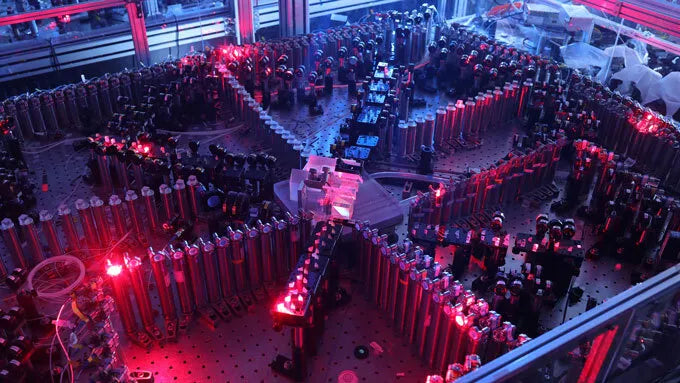
The USTC Jiuzhang-1 is a groundbreaking photonic quantum computer that achieved quantum supremacy in 2020 through Gaussian Boson Sampling.
The USTC Jiuzhang-1 system represents a pivotal moment in the history of quantum computing, marking China's first claim of quantum supremacy, or quantum advantage, in December 2020. Developed by the University of Science and Technology of China (USTC), this experimental prototype distinguishes itself by leveraging photons as its quantum information carriers, a stark contrast to the more commonly discussed superconducting or trapped-ion qubit architectures. Its primary achievement was demonstrating a computational task, specifically Gaussian Boson Sampling (GBS), that is practically intractable for even the most powerful classical supercomputers within a reasonable timeframe.
From a data analyst's perspective, understanding Jiuzhang-1 requires a shift in how we typically evaluate quantum systems. Unlike universal gate-based quantum computers that aim to solve a broad range of problems, Jiuzhang-1 is a specialized machine. Its design is optimized for a particular class of problems, showcasing the potential of analog quantum computation. The 'quantum advantage' demonstrated here refers to its ability to perform a specific, well-defined computational task significantly faster than any known classical algorithm. This is not to be confused with a universal quantum computer capable of running Shor's algorithm or Grover's algorithm, but rather a proof-of-concept for a specific quantum speedup.
The significance of Jiuzhang-1 lies not just in its raw computational speed for GBS, but also in validating photonic quantum computing as a viable pathway for achieving quantum advantage. Photonic systems offer unique advantages, such as operating at room temperature, which eliminates the need for complex and expensive cryogenic cooling systems required by superconducting qubits. This can potentially simplify hardware design and reduce operational costs in the long run, though they come with their own set of engineering challenges, particularly in maintaining quantum coherence and scaling up photon sources and detectors. The success of Jiuzhang-1 has spurred further research and development in photonic quantum technologies globally, highlighting the diversity of approaches in the race for practical quantum computers.
For analysts evaluating quantum hardware, Jiuzhang-1 serves as an excellent case study for understanding the nuances of quantum advantage claims. It underscores that 'quantum supremacy' is often task-specific and does not imply a general-purpose computational superiority across all problems. Instead, it highlights the potential for quantum devices to excel in niche areas where classical algorithms struggle. The system's performance metrics, particularly the number of detected photons and the speedup factor, provide concrete data points for assessing its capabilities within its specialized domain. This detailed examination allows for a more informed comparison with other quantum architectures, recognizing their distinct strengths and limitations.
The development of Jiuzhang-1 also contributes to the broader understanding of fundamental quantum mechanics, particularly in the realm of many-body quantum interference. The complex interplay of photons within its interferometer provides a rich experimental platform for exploring quantum phenomena at an unprecedented scale. While not directly accessible to the public or commercial users, its impact on the scientific community is profound, pushing the boundaries of what is experimentally achievable in quantum information science. This system, therefore, is not merely a computational device but also a powerful scientific instrument, offering insights that could pave the way for future, more versatile quantum technologies.
| Spec | Details |
|---|---|
| System ID | ustc-jiuzhang-1 |
| Vendor | USTC |
| Technology | Photonic |
| Status | Experimental prototype |
| Primary metric | 76 photons |
| Metric meaning | Maximum detected photons in Gaussian boson sampling |
| Qubit mode | Uses bosons (photons) in optical modes for sampling, not gate-based qubits |
| Connectivity | Full connectivity in 100-mode interferometer |
| Native gates | Linear optical transformations (beamsplitters, phase shifters) |
| Error rates & fidelities | Not specified |
| Benchmarks | GBS sampling rate ~10^14 faster than classical (2020) |
| How to access | Not public |
| Platforms | None |
| SDKs | None |
| Regions | N/A |
| Account requirements | None |
| Pricing model | None |
| Example prices | None |
| Free tier / credits | None |
| First announced | 2020-12-03 |
| First available | 2020-12-03 |
| Major revisions | None |
| Retired / roadmap | Active for research |
| Notes | First photonic supremacy; Hilbert space 10^30 |
Core Performance Metric: 76 Detected Photons in Gaussian Boson Sampling
The primary metric defining Jiuzhang-1's capability is its ability to detect up to 76 photons in a Gaussian Boson Sampling (GBS) experiment. This metric, 'Maximum detected photons in Gaussian boson sampling,' is crucial because the computational complexity of GBS scales dramatically with the number of detected photons. Achieving 76 detected photons within a 100-mode interferometer pushed the problem into a regime where classical simulation becomes extraordinarily difficult. For context, the previous record for GBS was significantly lower, making Jiuzhang-1's achievement a substantial leap forward. It's important to note that this is not a 'qubit count' in the traditional sense, as photonic GBS systems operate on optical modes and the bosonic nature of photons, rather than discrete, gate-addressable qubits.
Gaussian Boson Sampling (GBS) and Quantum Advantage
Jiuzhang-1's core function is to perform Gaussian Boson Sampling. GBS is a non-universal quantum computation task that involves sending squeezed light states (photons) through a complex optical interferometer, which performs linear optical transformations (beamsplitters and phase shifters). The output is then measured by single-photon detectors. The probability distribution of the detected photons at the output ports is what makes GBS computationally hard for classical computers to simulate. The 'benchmarks' provided indicate a GBS sampling rate approximately 10^14 times faster than the fastest classical supercomputer at the time (2020). Specifically, Jiuzhang-1 could generate a sample in about 200 seconds, a task that would take a classical supercomputer billions of years. This immense speedup is the essence of its quantum advantage claim.
Photonic Technology and Architecture
The system's underlying technology is entirely photonic. It utilizes 50 squeezed states as input, which are then directed into a 100-mode interferometer. The 'qubit_mode_explanation' clarifies that it 'Uses bosons (photons) in optical modes for sampling, not gate-based qubits.' This means that instead of manipulating individual qubits with gates, the system manipulates the quantum states of light (photons) as they propagate through the optical circuit. The 'connectivity_topology' is described as 'Full connectivity in 100-mode interferometer,' implying that any optical mode can interact with any other mode within the interferometer, which is a highly desirable feature for complex quantum interference. The 'native_gates' are 'Linear optical transformations (beamsplitters, phase shifters),' which are the fundamental operations required to implement the GBS algorithm.
Absence of Error Rates and Fidelities
A critical point for data analysts is the absence of specified 'error_rates_fidelities.' For experimental prototypes like Jiuzhang-1, detailed error rates for individual operations or overall system fidelity are often not publicly disclosed or are still under characterization. This is common in early-stage quantum hardware development, especially for analog systems where the concept of 'gate fidelity' might not directly apply in the same way it does for gate-based universal quantum computers. The validation of samples against alternatives, as mentioned in the short summary, suggests that the researchers focused on verifying the correctness of the output distribution rather than quantifying individual error sources. This lack of detailed error metrics makes direct comparability with gate-based systems challenging and underscores that Jiuzhang-1 operates in a regime where error correction, as understood in universal quantum computing, is not yet implemented or even applicable.
Trade-offs and Limitations
Jiuzhang-1, while demonstrating impressive speed for GBS, comes with inherent 'tradeoffs.' It is a 'High speed for specific tasks' but is 'Task-specific' and 'Not universal.' This means it cannot be programmed to solve arbitrary computational problems like a classical computer or a future universal quantum computer. Furthermore, it has 'No error correction,' which is a significant hurdle for scaling up quantum systems to solve practical, real-world problems that require high precision. The system's 'limits_shots' and 'limits_depth_duration' are 'Not applicable' because GBS is typically a single-run sampling experiment rather than an iterative computation with circuit depth or multiple shots. Its primary utility lies in proving quantum advantage and exploring fundamental quantum physics, rather than immediate commercial application. However, the 'what it is for' section suggests potential applications in 'graph theory' and 'optimization,' which are areas where GBS-like problems could find future relevance, albeit requiring further research and development to bridge the gap from theoretical advantage to practical utility.
Comparability and Future Outlook
When comparing Jiuzhang-1 to other quantum systems, it's crucial to recognize its unique position. It's not directly comparable to qubit-based systems by simply counting 'qubits.' Instead, its performance is measured by the complexity of the GBS problem it can solve, quantified by the number of detected photons and optical modes. Its 'no cryogenics' advantage is a significant engineering benefit, contrasting sharply with superconducting systems. While it is an 'Experimental prototype' and 'Active for research,' its success has undeniably pushed the boundaries of what is possible with photonic quantum computing, laying groundwork for future advancements in this distinct and promising quantum modality.
| System | Status | Primary metric |
|---|---|---|
| USTC Jiuzhang-2 | Experimental prototype | 113 photons: 113 |
The journey of the USTC Jiuzhang-1 system into the global quantum computing landscape began with its official announcement and first availability on December 3, 2020. This date is significant as it marked a major milestone for quantum computing research, particularly for photonic approaches and for China's contributions to the field. The announcement was made through a peer-reviewed publication in Science, a highly reputable scientific journal, lending significant credibility to the quantum advantage claim.
At the time of its unveiling, the quantum computing community was intensely focused on the concept of 'quantum supremacy' or 'quantum advantage,' following Google's Sycamore processor's claim in 2019 using superconducting qubits. Jiuzhang-1's announcement provided a crucial independent validation of quantum advantage using an entirely different physical platform – photons – and a different computational task – Gaussian Boson Sampling. This demonstrated that quantum advantage was not exclusive to one technology or one type of problem, thereby broadening the scope and validating the diverse research directions in quantum computing.
The immediate impact of Jiuzhang-1's announcement was substantial. It solidified the position of photonic quantum computing as a serious contender in the race for quantum advantage and spurred further investment and research into optical quantum technologies. The system's ability to perform a GBS task orders of magnitude faster than classical supercomputers, as detailed in the accompanying research paper, was a clear and compelling demonstration of quantum mechanics' computational power.
As an 'Experimental prototype,' Jiuzhang-1 has not undergone 'major revisions' in the sense of commercial product cycles. Instead, its evolution is characterized by ongoing research and refinement within the USTC laboratories. The system remains 'Active for research,' indicating its continued use as a platform for exploring advanced quantum phenomena, pushing the boundaries of GBS, and potentially investigating new applications for photonic quantum computing. While there haven't been public announcements of 'Jiuzhang-2' or similar direct successors, the principles and technologies demonstrated by Jiuzhang-1 undoubtedly inform subsequent research efforts in photonic quantum computing, both within USTC and globally. Its legacy is not just in its initial achievement but in its ongoing role as a foundational experimental platform for quantum science.
The development and announcement of Jiuzhang-1 also highlighted the growing global competition and collaboration in quantum technology. It showcased China's significant capabilities in quantum physics and engineering, adding another major player to the international quantum race. For data analysts tracking quantum hardware, Jiuzhang-1's timeline serves as a benchmark for the rapid progress in specialized quantum systems and the continuous expansion of the quantum advantage frontier beyond universal gate-based models.
Verification confidence: High. Specs can vary by revision and access tier. Always cite the exact device name + date-stamped metrics.
The primary function of Jiuzhang-1 is to perform Gaussian Boson Sampling (GBS), a specialized quantum computation task. It was designed to demonstrate quantum advantage by solving this problem significantly faster than classical supercomputers.
Jiuzhang-1 does not use 'qubits' in the traditional sense of gate-based quantum computers. Instead, it operates with photons in optical modes. Its capability is measured by the number of detected photons (up to 76) and the number of optical modes (100) in its interferometer.
Jiuzhang-1 demonstrated quantum advantage by performing Gaussian Boson Sampling approximately 10^14 times faster than the fastest classical supercomputers in 2020. This means it could complete a sampling task in about 200 seconds that would take classical machines billions of years.
No, Jiuzhang-1 is not a universal quantum computer. It is a task-specific machine optimized for Gaussian Boson Sampling. It cannot be programmed to solve arbitrary computational problems like a universal gate-based quantum computer.
No, the USTC Jiuzhang-1 is an experimental prototype and is not publicly accessible. It is used exclusively for research by the USTC team and is not available via cloud platforms, APIs, or for commercial/academic use by external parties.
Photonic quantum computing, as exemplified by Jiuzhang-1, offers advantages such as operation at room temperature, eliminating the need for complex cryogenic cooling. It also demonstrates a distinct pathway to achieving quantum advantage for specific computational problems.
No, Jiuzhang-1 does not incorporate error correction. As an experimental prototype focused on demonstrating quantum advantage for a specific task, the system operates without the complex error correction mechanisms typically envisioned for fault-tolerant universal quantum computers.